High-Density PCB Cluster Hole Processing: How Can Laser Drilling Achieve a Win-Win of Speed and Consistency
Anyone in the PCB manufacturing industry knows well that cluster hole machining of high-density interconnect (HDI) boards is the most severe bottleneck holding back production capacity. A single mobile phone mainboard carries thousands of microholes, with hole diameters ranging from 0.1mm to 0.3mm and a position tolerance of ±25μm.
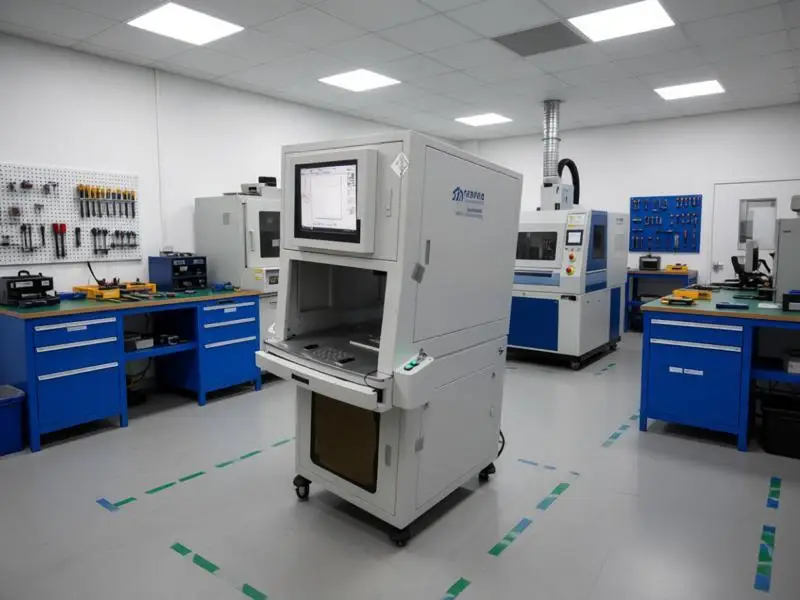
Processing Results
- Precision laser drilling
- laser micro-hole machining
- laser drilling machine
- laser drilling equipment
- jiajiayong laser drilling
Details
As peers in PCB manufacturing know well, cluster hole machining on High-Density Interconnect (HDI) boards is the most prominent pain point restricting production capacity. A single mobile phone mainboard has thousands of microholes, with diameters ranging from 0.1mm to 0.3mm and a position tolerance of ±25μm.
If mechanical drilling is applied, a drill bit needs replacement after drilling thousands of holes, and the downtime for tool change even exceeds the processing time. Moreover, as the drill bit wears down, the hole diameter gradually increases, leading to a difference of several micrometers between holes drilled at the early and late stages of a bit's service life. The emergence of laser drilling has fundamentally changed this situation. Jiajiayong Laser has focused on precision drilling for 29 years, and today we would like to discuss how the laser solution stands out in terms of speed and consistency in high-volume cluster hole machining.
Ⅰ、Speed Advantage: "Overall Efficiency" Rather Than "Single-Hole Speed"
Many people assume that the speed advantage of laser drilling lies in the time required for a single hole. In fact, for high-density cluster holes, the real efficiency improvement comes from three aspects:
1. No Tool Change Required
Mechanical drills need to replace the drill bit after every 2,000 to 5,000 holes, and each tool change plus alignment takes 3 to 5 minutes. If a board has 5,000 holes, production has to be paused halfway for tool replacement. Laser drilling has no tool wear and can operate continuously for more than 8 hours without downtime. For production lines with a daily output of 10,000 boards, the time saved from eliminating tool changes alone can reach 1 to 2 hours per day.
2. Flying Drilling Mode
Jiajiayong Laser's equipment adopts high-speed galvanometer + flying drilling technology: the galvanometer can emit laser light during movement, without needing to stop at each hole position. Combined with a dual-station rotary table, loading and unloading can be carried out at one station while the other station is in processing, enabling a comprehensive takt time of more than 6,000 holes per minute. Taking an HDI board with 5,000 holes as an example, mechanical drilling takes 15 to 20 minutes, while laser drilling only takes 3 to 5 minutes.
3.Automated Connection
The equipment can be connected to automatic loading and unloading manipulators and AGVs to realize 24-hour unattended operation. During night production, one operator can manage 3 to 5 units of equipment, greatly reducing labor costs.
Ⅱ、Consistency Advantage: From "Craft Dependent" to "Algorithm Driven"
What is the biggest concern in cluster hole machining? It is hole diameter drift and hole position deviation. The hole diameter of mechanical drilling will gradually increase with the wear of the drill bit, and there may be a difference of 5 to 10μm between the first board and the last board processed with the same set of tools. Laser drilling completely avoids this problem – as long as the parameters are locked, the diameter difference between the 1st hole and the 10,000th hole can be controlled within ±1μm.
However, laser drilling also has its own challenges: board expansion and contraction, and changes in ambient temperature. PCBs will have micron-level expansion and contraction during the lamination process, and the expansion and contraction values vary between batches. If the equipment drills holes according to fixed coordinates, the hole positions will deviate. Jiajiayong Laser's solution is "CCD visual positioning + adaptive compensation". Before processing, the equipment first identifies the Mark points on the board edge, calculates the actual expansion and contraction amount and rotation angle of the whole board, and then corrects the coordinates of each hole in real time. Measured data shows that when processing 10,000 holes on a 500mm×500mm board, all hole position errors are controlled within ±10μm, and the CPK is stable above 1.67.
For hole diameter consistency, we adopt the "in-line measurement closed-loop" technology. After processing each row of holes, the coaxial camera immediately measures the hole diameter. If a deviation trend is detected, the system automatically fine-tunes the laser energy or focus position to ensure consistent hole diameter across the whole board. This technology reduces the standard deviation of cluster hole diameters from the traditional 3-5μm to less than 1.5μm.
Ⅲ、Comprehensive Cost: The Real Winner Shows When Calculating the Overall Account
Many customers think that laser equipment is more expensive than mechanical drills, with high one-time investment. But if we calculate the total cost over three years, the conclusion is often the opposite.
Take an annual output of 1 million HDI boards, each with 5,000 microholes, as an example:
1.Mechanical drilling solution: Equipment investment is about 800,000 yuan (for 10 drilling machines), annual tool cost is about 400,000 yuan (each drill bit costs 50 yuan, replaced after every 3,000 holes), annual labor cost for post-processing (deburring) is 150,000 yuan, annual loss from 3% scrap rate is about 300,000 yuan (calculated at 10 yuan per board), totaling about 3.75 million yuan in three years.
2.Laser drilling solution: Equipment investment is about 1.5 million yuan (for 3 laser machines), annual cost of consumables (lenses, gas) is about 30,000 yuan, annual electricity cost is about 20,000 yuan, no post-processing is required, annual loss from 0.5% scrap rate is about 50,000 yuan, totaling about 1.8 million yuan in three years.
The laser solution saves nearly 2 million yuan in three years, and the equipment still has surplus production capacity to take on more orders. More importantly, the laser solution has excellent consistency, leading to a low customer return rate, and the improvement of brand reputation cannot be measured by numbers.
Ⅳ、Cluster Hole Processing Capability of Jiajiayong Laser
Based on 29 years of technology accumulation, Jiajiayong Laser has achieved the following deliverable indicators in the field of high-density PCB cluster hole processing:
· Minimum hole diameter: 3μm (with dedicated focusing module)
· Processing accuracy: ±1μm (static repeat positioning)
· Maximum drilling speed: 100 holes per second (for thin boards)
· Cluster hole array position accuracy: ±10μm (with visual compensation)
· Hole diameter consistency: CPK ≥ 1.67
· Hole wall quality: No burrs, no flashes, no secondary processing required
· Material compatibility: FR-4, high-frequency boards, flexible PI, metal substrates, ceramic substrates, etc.
· Automation integration: Support automatic loading and unloading, in-line inspection, MES connection
The equipment supports exclusive non-standard customization, and we can design the optimal automation solution according to the customer's board size, number of holes, and takt time requirements. At present, multiple cluster hole processing production lines are operating stably at customer sites, and the daily production capacity of a single machine exceeds 2,000 boards (calculated at 5,000 holes per board).
Ⅴ、Suggestion for You: Test Sample First, Then Calculate the Cost
The efficiency improvement of high-density PCB cluster hole processing cannot be automatically realized just by purchasing a piece of equipment. It requires the combination of equipment capability, process experience, and automation solutions. Jiajiayong Laser suggests: send samples first, then make a decision.
Send your PCB samples and drawings to our Shenzhen Application Verification Center, and we will provide free sample processing. A process report including the following contents will be issued within 3-5 working days: hole diameter CPK, hole position accuracy measurement data, takt time estimation, and three-year total cost comparison. If you think it is suitable, we can further discuss the equipment solution; if not, you will at least get a set of professional data, which is also valuable for your subsequent process improvement.
For 29 years, the tenet of Jiajiayong Laser has remained unchanged: Let there be no hard-to-drill holes in the world. No matter how dense and numerous the high-density cluster holes are, we can help you find the most efficient solution.
Need a similar processing solution?
Contact our technical experts for a customized solution
Contact Us: 18927447628