Precision Requirements and Solutions for Laser Drilling of New Energy Vehicle Battery Electrode Sheets
Anyone working in the lithium-ion battery electrode sheet processing industry is fully aware that the micro-holes on the electrode, though not core standalone components of the battery, have a non-negligible impact on overall cell performance.
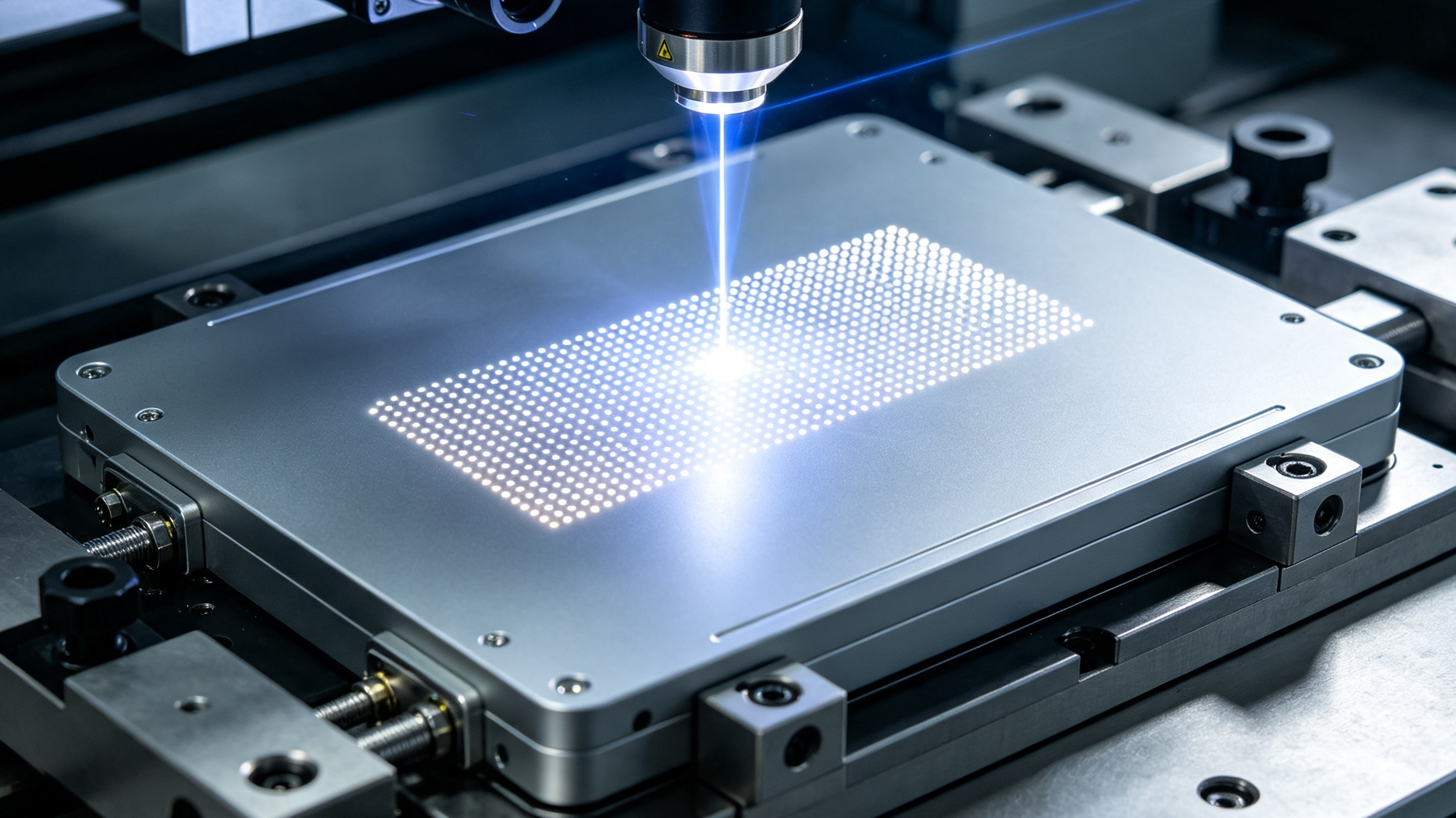
Processing Results
- precision laser drilling
- laser micro-hole machining
- laser drilling machine
- laser drilling equipment
- jiajiayong laser drilling machine
Details
For those working in the lithium-ion battery electrode sheet manufacturing sector, it is common knowledge that the micro-holes on electrode sheets, though not core standalone components of the battery, exert a non-negligible impact on battery performance. Machining micro-holes on the aluminum or copper foil after electrode coating can improve electrolyte wettability, shorten lithium-ion transmission paths, and enhance rate performance. However, electrode materials are extremely thin (typically 10-20μm), soft in texture, and have fragile coatings. Traditional mechanical punching can easily cause foil tearing, coating peeling, and burr-induced short circuits. Jiajiayong Laser, which has focused on precision drilling for 29 years, has established in-depth cooperation with the Laser Institute of the Chinese Academy of Sciences and served more than 500 enterprises. Today, we would like to discuss how strict the precision requirements are for laser drilling of new energy vehicle battery electrode sheets, and how our laser solutions meet these requirements one by one.
I. Unique Challenges in Battery Electrode Drilling
Extremely thin, soft, and prone to deformation. The thickness of aluminum and copper foils usually ranges from 8 to 20μm, thinner than a human hair. Mechanical contact processing methods, whether punching or drilling, will exert tension and extrusion on the foil, leading to burrs around the holes and overall deformation of the foil. If these burrs pierce the separator, they will cause internal short circuits in the battery, which is a serious safety hazard.
Fragile coating that is easy to peel off. The bonding force between the active materials coated on the electrode surface (such as NCM, LFP) and the foil is limited. Mechanical impact will cause the coating to peel off around the holes, exposing the bare foil, which not only affects the capacity but also increases the internal resistance. The non-contact processing method of laser fundamentally avoids this problem.
High requirements for batch consistency. A single battery electrode may have hundreds of micro-holes, and the aperture, position, and hole wall quality of each hole must be consistent. If burrs or coating peeling on a single hole cause local short circuit, the entire battery may be scrapped. Therefore, the aperture tolerance is usually required to be within ±5μm, with no burrs and no heat-affected zone on the hole wall.
II. Limitations of Traditional Processes
Mechanical punching is the most common electrode drilling method at present, but its drawbacks are obvious: burrs increase after the mold wears out, requiring frequent mold replacement; although the punching speed is fast, the downtime for mold change is long; different molds are required for different hole types and arrangements, resulting in poor flexibility.
Although chemical etching can process thin foils, the etching solution will react with the coating, leading to deterioration of coating performance. Moreover, the undercut phenomenon in etching will make the hole wall trapezoidal, making it difficult to control the aperture accuracy.
If the parameters of traditional laser drilling are not properly set, the heat-affected zone will burn the coating, or a recast layer will be formed on the hole wall, which will also affect battery performance.
III. Jiajiayong Laser's Solution: Cold Processing + Precision Control
In response to the particularity of battery electrode sheets, Jiajiayong Laser has developed a dedicated precision micro-hole processing solution:
Femtosecond laser cold processing with heat-affected zone <1μm. The pulse width of the femtosecond laser is extremely short (<400fs), far less than the thermal diffusion time of the material. The laser energy is directly used to break the chemical bonds of the material, rather than being converted into heat energy. Therefore, there is almost no heat conduction in the processing area, the coating is not affected, the foil does not deform, and there is no recast layer on the hole wall. Observed under SEM, the coating around the hole is intact, no different from the unprocessed area.
Non-contact processing with zero burrs and zero deformation. The laser beam scans at high speed through the galvanometer, without any physical contact with the workpiece. The foil remains naturally flat during processing, without tension, wrinkles or burrs. The processed electrode can directly enter the next process without any post-treatment.
Online visual positioning and adaptive compensation. There may be minor position deviations during electrode conveying. The equipment identifies the electrode edge and Mark points in real time through the CCD vision system, and automatically compensates for position deviations to ensure that each hole is drilled at the preset coordinate. At the same time, the online aperture detection module measures once per row of holes processed, and immediately fine-tunes the energy parameters when a deviation trend is detected, controlling the aperture standard deviation of the entire electrode within 1.5μm.
IV. Jiajiayong Laser's Delivery Capability in the Battery Electrode Sector
Based on 29 years of technical accumulation and more than 500 precision micro-hole cases, Jiajiayong Laser has achieved the following verifiable engineering indicators for new energy vehicle battery electrode processing:
| Indicator Item | Measured Value |
| Minimum Machining Aperture | 10μm |
| Machining Accuracy (Static Repeat Positioning) | ±1μm |
| Maximum Drilling Speed | 100 holes/second |
| Aperture Consistency CPK | ≥1.67 |
| Hole Wall Quality | No burrs, no recast layer, no heat-affected zone |
| Material Compatibility | Aluminum foil, copper foil, coated electrodes (NCM/LFP, etc.) |
| Supported Hole Types | Round holes, square holes, special-shaped holes, hole array |
| Maximum Processing Format | 600mm×600mm (roll-to-roll customizable) |
| Automation Integration | Supports roll-to-roll automatic loading and unloading, visual positioning, online detection, MES docking |
The equipment supports exclusive non-standard customization, and can provide complete solutions from stand-alone machines to fully automatic production lines according to the electrode material, thickness, coating type, and aperture arrangement. Our tenet is: Make no hole difficult to drill in the world.
V. Suggestion for You: Send Samples for Verification, Let Data Speak
Laser drilling of battery electrodes is directly related to the safety and consistency of batteries. The most reliable way is to send a batch of your electrode samples and drawings to our Shenzhen Application Verification Center. We provide free sample processing, and will issue a process report including the following contents within 3-5 working days:
1. Aperture CPK and full-sheet consistency data
2. SEM photos of the hole wall (magnified 5000 times, verifying no burrs and no heat-affected zone)
3. Coating integrity test (verifying no peeling and no cracks)
4. Cycle time estimation and three-year total cost comparison
If you find the solution suitable, we can further discuss the equipment plan; if not, you will at least obtain a set of professional data, which is also valuable for your subsequent process improvement.
For 29 years, the tenet of Jiajiayong Laser has remained unchanged: Make no hole difficult to drill in the world. For the precision micro-holes of new energy vehicle battery electrodes, we will work with you, starting from micron-level precision, to support the safety and performance of every battery.
Need a similar processing solution?
Contact our technical experts for a customized solution
Contact Us: +8618682295530