How to Ensure Hole Diameter Consistency in 2000-Mesh Precision Screen Laser Drilling?
Technology News · 2026/8/17 · 29 views
Those in the filter screen industry know that a 2000-mesh screen requires a hole diameter of approximately 6.5 microns and a hole spacing of only tens of microns.
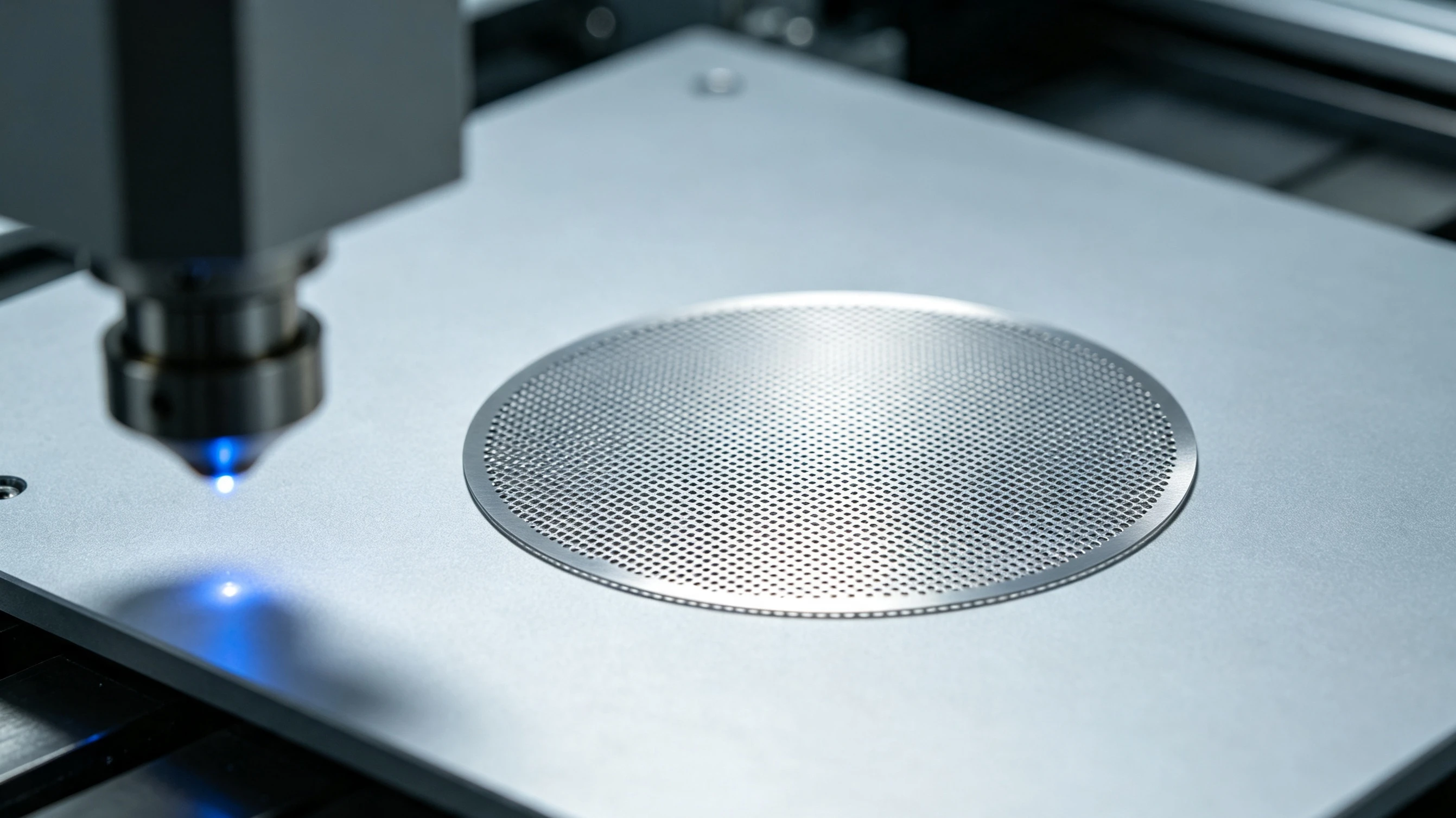
Those in the filter screen industry know that a 2000-mesh screen requires a hole diameter of approximately 6.5 microns and a hole spacing of only tens of microns. Achieving high-volume, highly consistent precision drilling at such a microscopic scale is one of the most widely recognized technical challenges in the laser processing field. This article provides an in-depth analysis of how to ensure hole diameter consistency in 2000-mesh precision screen laser drilling, from two dimensions: technical challenges and solutions.
1. Core Technical Challenges in 2000-Mesh Screen Laser Drilling
The hole diameter of a 2000-mesh screen is only about 6.5 microns — a dimension that approaches the diffraction limit of many commonly used laser wavelengths. At this scale, even the slightest process fluctuation gets amplified, directly manifesting as hole diameter deviation.
1.1 Heat-Affected Zone Control
Laser drilling is essentially a process of localized melting and vaporization. At micron-scale hole diameters, even a 1–2 micron expansion of the heat-affected zone (HAZ) can cause the actual hole diameter to deviate from the design value. This is especially true for metallic screen materials such as stainless steel 316L, which has a high thermal conductivity — heat tends to spread laterally along the hole wall, causing irregular enlargement of the hole diameter.
1.2 Pulse Energy Fluctuation
The single-pulse energy fluctuation of conventional pulsed lasers typically ranges from ±3% to ±5%. For a 2000-mesh screen, energy fluctuation directly translates into hole diameter variation — higher energy produces larger holes, while lower energy results in smaller holes or even incomplete penetration. When a single screen contains hundreds of thousands of holes, the cumulative hole diameter dispersion severely compromises filtration accuracy.
1.3 Positioning Accuracy and Repeat Positioning Error
The hole spacing of a 2000-mesh screen is approximately 12.7 microns (25.4 mm ÷ 2000). This means the positioning accuracy of the machining system must be at the sub-micron level, and the repeat positioning error must not exceed 1 micron. During large-format processing, traditional galvanometer scanning systems introduce non-negligible positioning deviations due to field lens distortion and thermal drift.
2. Key Technical Solutions for Ensuring Hole Diameter Consistency
To address the above challenges, the industry has developed a full-chain control solution spanning from the laser source to the process parameters.
2.1 Introduction of Ultra-Short Pulse Lasers
Picosecond (ps) and femtosecond (fs) laser pulses have extremely short pulse widths (10⁻¹² to 10⁻¹⁵ seconds). The energy is removed from the material before it has time to conduct to the surrounding area, fundamentally minimizing the heat-affected zone. Experimental data shows that using picosecond lasers to process 2000-mesh stainless steel screens can confine the HAZ to within 500 nanometers, with hole diameter consistency (standard deviation) better than ±0.3 microns.
2.2 Beam Quality and Energy Closed-Loop Control
Lasers with high beam quality (M² < 1.3) ensure uniform and repeatable energy distribution at the focal spot. Combined with a real-time energy monitoring system that performs online detection and feedback adjustment for every pulse, pulse energy fluctuation is compressed from ±3% to within ±0.5%, ensuring highly consistent material removal for each hole.
2.3 High-Precision Motion Platform and Vision Alignment
A motion platform driven by air-bearing linear motors achieves positioning accuracy of ±0.1 microns and repeat positioning accuracy of ±0.05 microns — far superior to traditional ball-screw plus servo solutions. Additionally, an integrated CCD vision alignment system identifies and corrects screen fiducial marks before processing, eliminating positioning errors caused by material clamping deviation and thermal deformation.
2.4 Process Parameter Database and Adaptive Tuning
For screens of different materials and thicknesses, a comprehensive process parameter database is established (including pulse energy, pulse width, repetition rate, defocus amount, scanning speed, etc.). During processing, the system automatically fine-tunes parameters based on real-time monitoring data, ensuring stable hole diameter consistency even in the presence of disturbances such as material batch variations and ambient temperature changes.
3. Quality Inspection and Verification Methods
Ensuring hole diameter consistency relies not only on process control during machining but also on rigorous inspection and verification. Commonly used inspection methods include:
Optical microscope measurement: Sampling holes are observed at high magnification (500× or above) to measure actual hole dimensions and calculate the mean and standard deviation.
Scanning Electron Microscope (SEM): Nanoscale observation of hole wall morphology and heat-affected zone extent is performed to validate the reliability of the process solution.
Airflow permeability testing: By measuring the standard air permeability of the screen, overall hole diameter consistency is indirectly evaluated — a method suitable for rapid screening of large-volume production.
4. Summary
Ensuring hole diameter consistency in 2000-mesh precision screen laser drilling is a systems engineering challenge that requires multidisciplinary coordination across laser sources, motion control, process parameters, and in-line monitoring. By adopting a comprehensive technical approach — including ultra-short pulse lasers, energy closed-loop control, high-precision motion platforms, and adaptive process tuning — hole diameter consistency can be maintained within ±0.3 microns, meeting the stringent requirements of high-end filtration applications.
If you have technical requirements or questions regarding precision screen laser drilling, please feel free to contact us. We will provide you with professional technical solutions and processing services.
Related Articles
- Cracking the Precision Code of FEP Precision Drilling: A Systematic Practice from Material Properties to Process Control
- An In-Depth Analysis of Laser Drilling Technology for Sieving Meshes: From Core Principles to Industry Applications
- How small a hole can lasers machine? An analysis of the technical boundaries of precision micro-hole machining