Laser Solution for Hole Expanding and Irregular-shaped Hole Machining of Medical Catheters
Industry News · 2026/10/17 · 3 views
As anyone working in the medical catheter industry knows, more often than not, customers require more than just a simple round hole. The required structure can be a curved groove on the side wall of a drainage catheter, a flared opening at the tip of a balloon catheter, or a rectangular opening in the middle of a multi-lumen catheter.
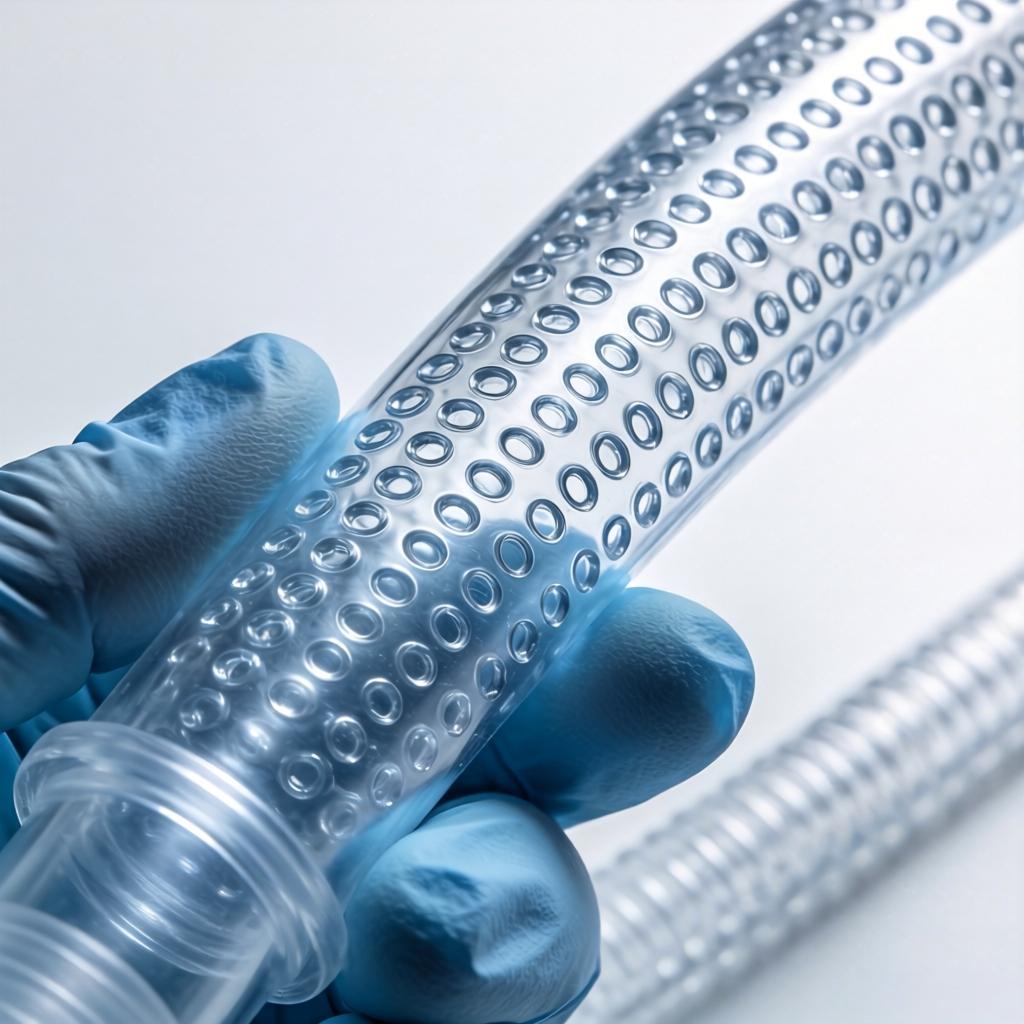
As anyone working in the medical catheter industry knows, more often than not, customers require more than just a simple round hole. The required structure can be a curved groove on the side wall of a drainage catheter, a flared opening at the tip of a balloon catheter, or a rectangular opening in the middle of a multi-lumen catheter. These irregular-shaped holes and expanded holes are often designed to achieve specific functions: precise fluid control, good device passability, or ideal tissue conformity. But turning these designs from drawings to physical parts, especially consistent quality parts for mass production, is far more complex than many people expect.
Jiajiayong Laser has been specializing in laser hole drilling for 29 years, and most of our work deals with all kinds of "difficult-to-machine holes". Today, we would like to walk you through how to practically implement a laser solution for irregular-shaped hole machining and hole expanding of medical catheters.
Ⅰ、he first hurdle for irregular-shaped hole machining: the catheter itself does not hold a stable shape
It is easy to draw a perfect ellipse on a straight TPU tube. But during actual machining, catheters are soft: over-clamping causes deformation, while under-clamping leads to positional shift. To make things worse, many catheters come with a natural bend out of the factory – such as gastric tubes and nasogastric feeding tubes. If you fire the laser vertically when machining a curved hole on such a bent surface, the wall thickness on the two sides of the hole will be uneven: one side may be fully penetrated while the other remains uncut.
Our solution is: don’t rush machining. After loading the catheter into the equipment, we use a 3D profile scanning head to scan the catheter and input its actual bent morphology into the system. Then in the software, we "map" the required curved hole onto the bent surface, and the software automatically calculates the incident angle compensation for the laser at every position. During machining, the galvanometer moves along the compensated trajectory, which means the laser beam always remains perpendicular to the curved surface in virtual space. With this method, no matter how the catheter is bent, the taper difference between the two side walls of the machined curved hole can be controlled within 2 microns.
Ⅱ、The second hurdle for irregular-shaped hole machining: "thermal burn" at sharp corners
Round holes are easy to machine: you just scan circle by circle. But for shapes with sharp corners like rectangular holes, triangular holes and oblong holes, problems arise: when the laser approaches a sharp corner, it has to slow down to turn. The slower speed leads to energy accumulation, which easily causes material bulging or even carbonization. If you reduce the laser power to avoid burning, the sharp corner may not be fully cut through.
We solve this contradiction with our proprietary variable speed & variable power technology. Simply put: the laser runs at high speed on straight sections (e.g. 500 mm per second) with full power; when it is about one hair width away from the sharp corner, it starts to gradually decelerate, and the power is also reduced proportionally to the square of the speed – if the speed is halved, the power is reduced to a quarter. This ensures that the energy density at the sharp corner is exactly the same as on the straight section, eliminating both burning and incomplete cutting. We have tested this on stainless steel, titanium alloy and TPU, and the heat affected zone (HAZ) at the four corners of a rectangular hole is completely consistent with that on the straight edges.
Ⅲ、Hole expanding: it is far more than just making an existing hole larger
Some catheters require hole expanding at the tip, such as the tapered inlet of a balloon catheter or the flared opening of a drainage catheter. Hole expanding is not simply scanning a circle with a larger diameter, because it usually requires strict angle tolerance (e.g. 30-degree taper angle), and the inner wall must be smooth with no steps.
Our solution is the taper scanning mode: as the laser focus moves inward from the catheter tip, the scanning radius increases linearly to form a conical surface. Combined with automatic focus tracking, this ensures consistent energy density across the entire tapered surface. With this method, the taper angle accuracy can be controlled within ±0.5 degrees, and the inner wall roughness Ra ≤ 0.2 μm, eliminating the need for post-processing polishing.
Ⅳ、The final checkpoint for mass production: how to inspect so many irregularly shaped holes?
Unlike round holes, irregular-shaped holes cannot be inspected with a simple go/no-go gauge. Every dimension needs to be measured: for oblong holes, that's major axis, minor axis and arc radius; for rectangular holes, that's side length, diagonal and corner radius. If every part has to be sent to a vision measuring machine, the production line cannot operate at full capacity.
We added an in-situ machining & inspection function to our equipment: right after a hole is machined, the coaxial high-magnification camera takes an image immediately, the software automatically identifies the hole profile, and compares it against the drawing tolerances. Out-of-tolerance parts trigger an on-site alarm and stop machining, while qualified parts proceed to the next step. This eliminates the need for additional inspection processes and the risk of missed inspection. When customers conduct quality audits, we can export the inspection data of every single catheter, which can be directly integrated into their quality management system.
Ⅴ、What types of irregular-shaped holes can Jiajiayong Laser machine?
To be honest, we have processed more hole types over the years than most engineers have encountered in their careers. Below are just some of the irregular hole types we have delivered in mass production:
1、Curved hole: Arc-shaped groove extending along the catheter axis, used for drainage or drug release
2、Oblong hole: Track-shaped hole with rounded ends and straight sides, commonly used for stents or filters
3、Rectangular/square hole: Right-angle hole with rounded corners, used for device channels or observation windows
4、Triangular hole: Designed for specific hydrodynamic requirements
5、Flared expanding hole: Tapered expansion at the catheter tip, used for balloon catheters or connectors
6、Stepped hole: Hole with segmented inner diameter changes, used for positioning or sealing
7、Spirally arranged irregular holes: Multiple irregular holes distributed along a spiral line on the catheter surface
Ⅵ 、low-risk next step for you
If you have a requirement for irregular-shaped hole machining or hole expanding, whether for prototyping or mass production, the most straightforward approach is to send us your samples. Just send us your catheters and drawings, and we will deliver a detailed process report within 3-5 working days, including aperture CPK (Process Capability Index), SEM images of the hole wall, cycle time estimation and cost comparison.
For 29 years, our mission has remained unchanged: to make no hole undrillable. This is not just a slogan – it is the motivation that drives us to tackle all kinds of unconventional hole designs every day.
Related Articles
- Precision Micro-hole Machining: Laser Drilling Solutions for Fuel Injector Nozzles, Suction Nozzles and Filter Nozzles
- High-Precision Femtosecond Laser Micro-Hole Machining: An Ideal Solution for Fine and Small Holes in Ruby
- How to achieve precision micro-hole machining of medical PEEK polymer materials